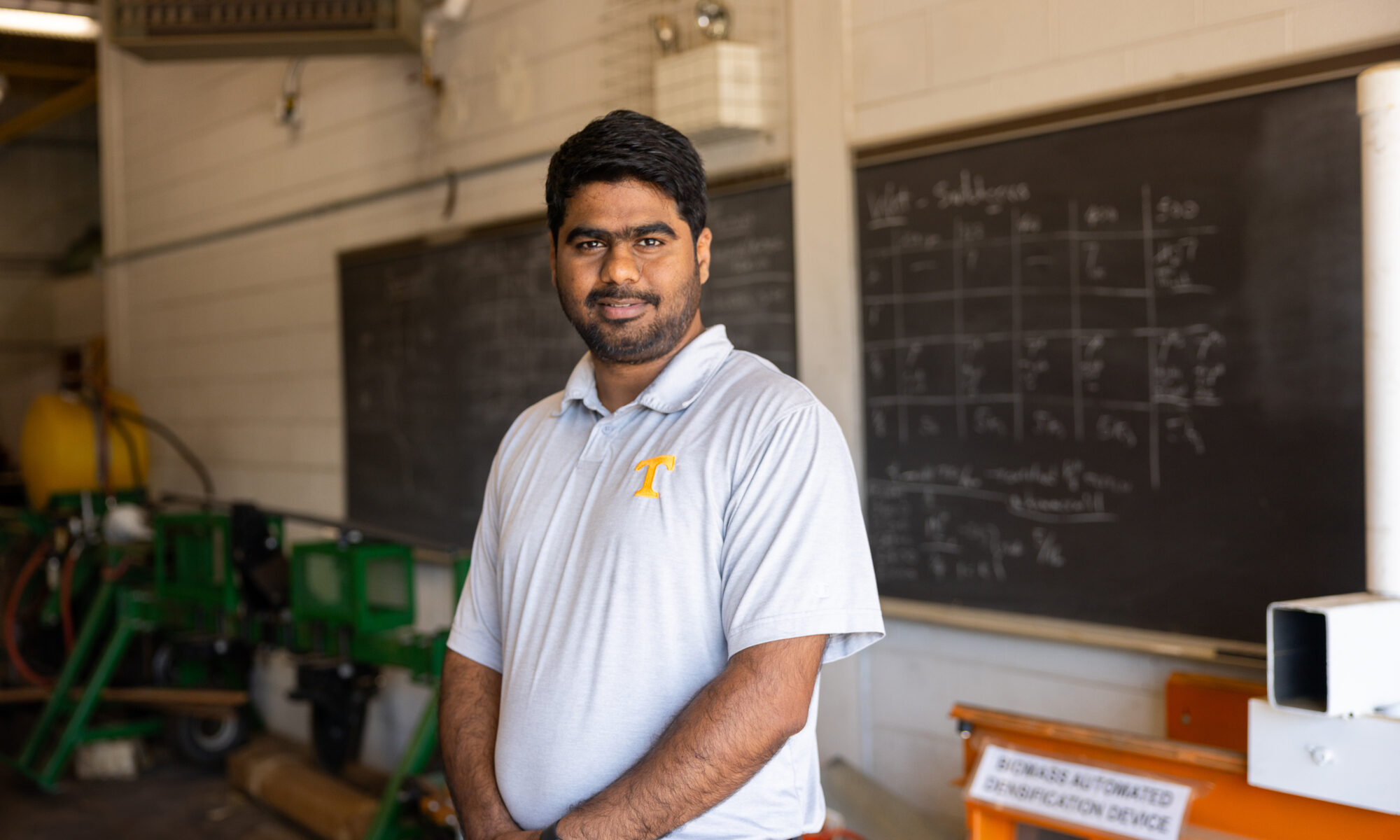
Biosystems engineering and soil science assistant professor advances agricultural innovation through robotics and automation
Where are you from, and how did your education and career lead you to the University of Tennessee Institute of Agriculture?
I’m from the state of Maharashtra, India. I’m an agricultural engineer by training, and all my degrees are in agricultural engineering. I completed my bachelor’s and master’s in India. My master’s was in the state of Punjab, popularly known as the “wheat basket” of India. For my PhD, I moved to Kansas, which happens to be the “wheat basket” of the United States. So yes, I basically followed the wheat! Right before defending my PhD, I came across a new opening in Knoxville with the UT Department of Biosystems Engineering and Soil Science, and it felt like a perfect fit for my education, skills, and expertise.
What inspired you to pursue a career in agricultural engineering?
My grandparents had — and still have — a small farm back in India. Growing up, I saw firsthand how difficult farming could be. There was a constant struggle for labor, rising costs, and it didn’t always feel safe. We had a pair of bulls on the farm, and they were essentially our tractor! I still remember how fun it was riding on the bullock cart. Farming was hard, but moments like those made it special. I used to help them whenever I could. Labor was so short that they would ask us to pitch in on weekends. I remember hand-picking cotton, collecting harvested onions, and irrigating plots. Farming was hard then, and it still is today. Somewhere in those long days in the field, I decided I could do something to help, and that’s what led me to pursue a degree in agricultural engineering.
What is your research focus in the UT Department of Biosystems Engineering and Soil Science, and why is it important?
As an agricultural engineer, I enjoy working at the intersection of sensors, robots, data, and models to improve food production agriculture. U.S. agriculture faces unprecedented challenges like rising production costs, labor shortages, and labor safety. My research program addresses these challenges by developing automation and robotic systems to make farming more profitable, efficient, and sustainable.
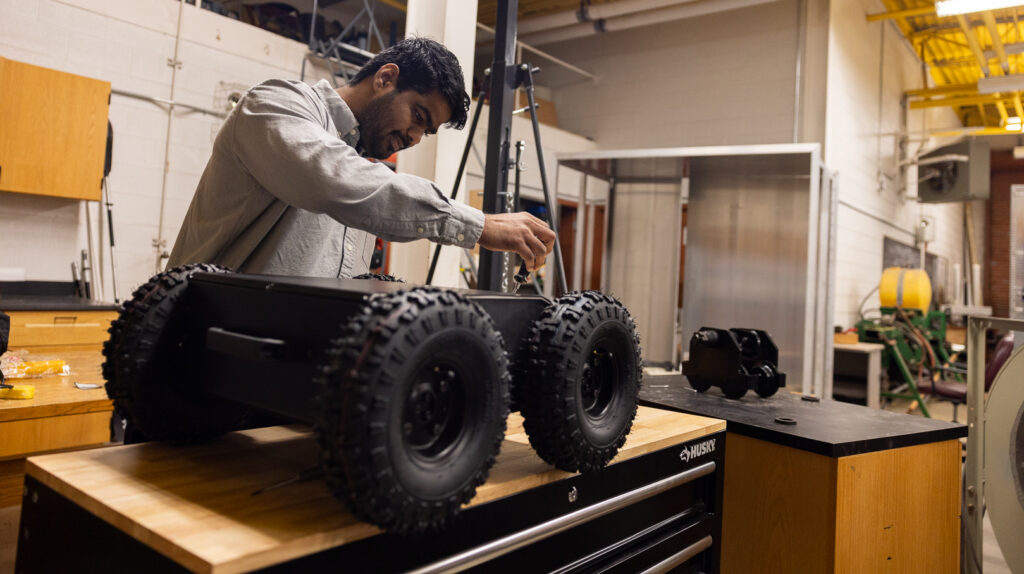
How are you incorporating artificial intelligence into agricultural equipment and robotic systems, and what kinds of decisions can AI help improve?
It all comes down to building feedback-driven, data-informed systems that help decide when and where to act. For example, one of our current NIFA-funded projects uses a robotic and AI-based system to detect pests in large grain storage structures — some as big as 10,000 square feet. The goal is to make informed decisions about where and when to fumigate, instead of treating the entire facility blindly.
In another project, we’re developing an AI-enabled robotic system for bird deterrence. The robot first identifies, using AI, what types of birds are present in the field and then triggers multiple deterrent methods to prevent bird contact with produce, reducing the risk of foodborne pathogen spread. It’s like having a smart scarecrow that actually knows what it’s looking at and can also move across the field to be more effective.
What are some of the main challenges to using advanced technology like robotics and AI in farming operations?
Farming is unstructured, diverse, and complex. No two fields, seasons, or days are exactly alike, not even two strawberries on the same plant. When robotics and AI are introduced in agriculture, they often struggle to understand the unstructured nature, diversity, and complexity that come with agricultural environments. But here’s how I think about it: if we as humans can put a robot on Mars — millions of miles away, on a planet we know almost nothing about — then why is it so hard to put robots on a farm, a place we know every inch of?
Despite the challenges of unstructured environments, system complexity, and technology costs, I remain deeply optimistic. I believe small robots and AI will not just advance farming — they will revolutionize it. In my lifetime, I hope to see small, AI- and solar-powered autonomous robots working alongside humans on the farm, as naturally as a tractor in the field.
What has been one of the most rewarding parts of your work so far?
It’s the moments when something you doubted would work, and you still try, and it does work. Challenging your own beliefs and being proven wrong — in a good way — is incredibly rewarding.
Beyond the research itself, it’s the students. They are full of energy and ideas. Working with them keeps the momentum going, and their enthusiasm is contagious. That energy is always there, and it makes every day exciting.
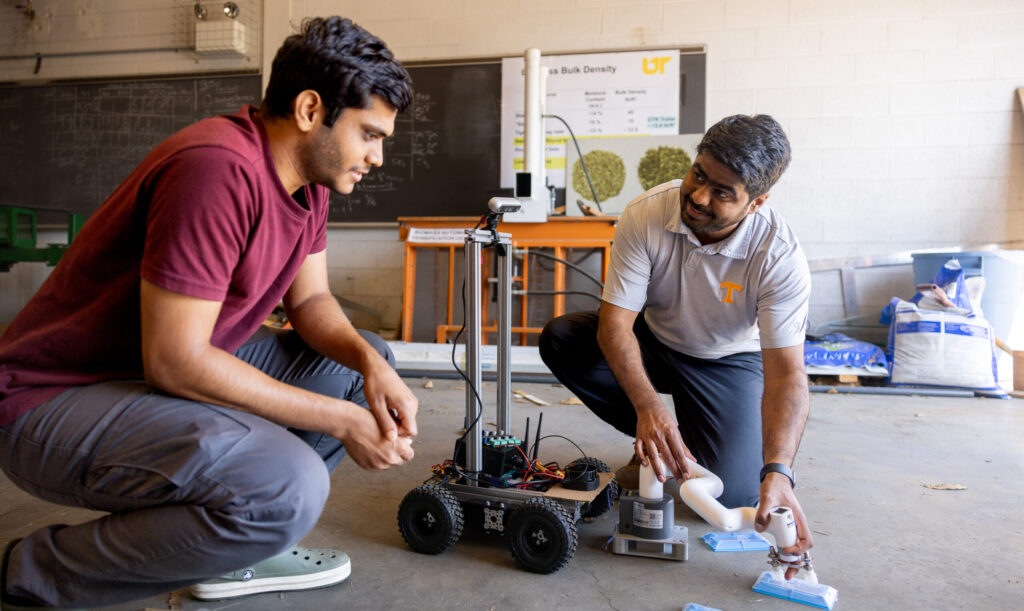
You recently received a $362,000 grant from the Center for Produce Safety in collaboration with UT Knoxville. Can you describe the project and what it aims to accomplish in improving composting systems?
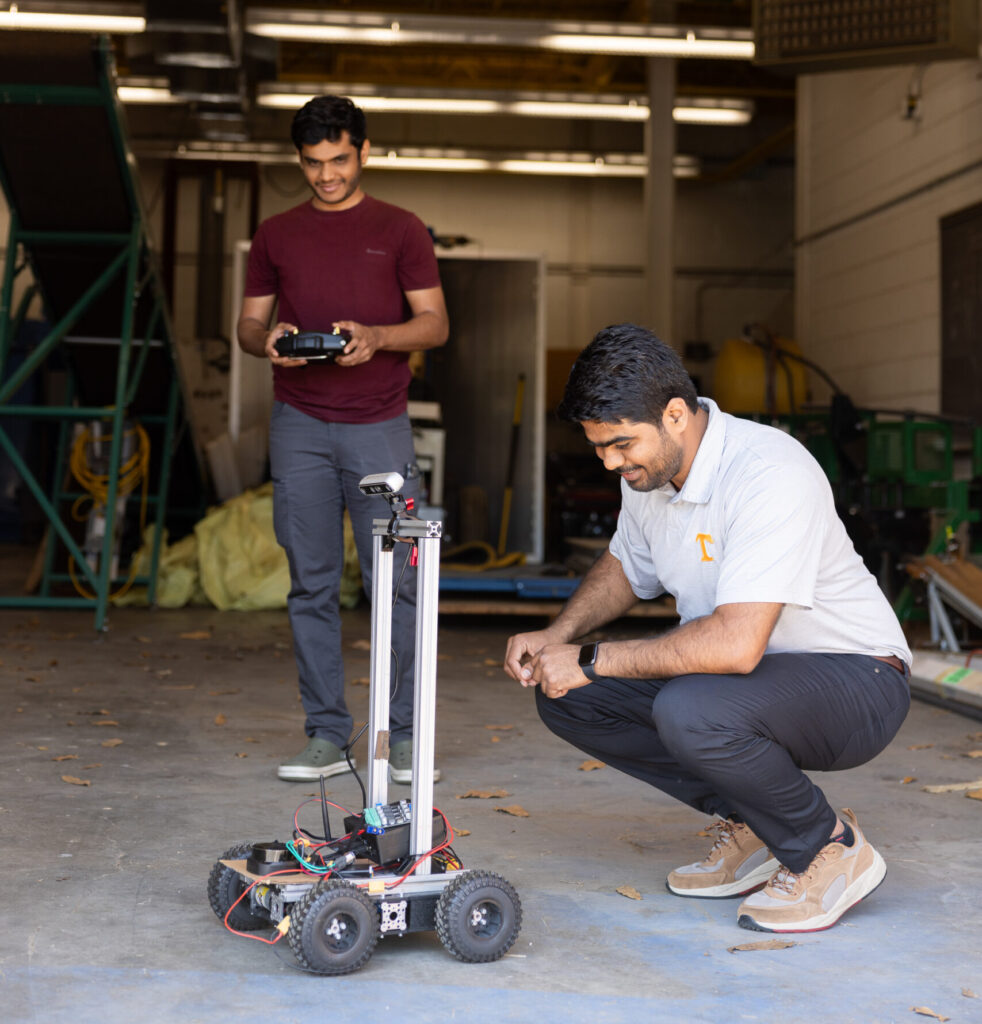
This project is all about bringing automation to compost temperature monitoring by integrating low-cost temperature sensors, a ground robotic platform, and machine learning. Right now, measuring compost temperature manually is very labor-intensive, costly, and prone to cross-contamination risk. Our hope is that one day, a robot will do that for us — autonomously navigating compost windrows, collecting data, and reporting it back to a digital dashboard. In short, we’re using robotics and automation to reduce cost, labor, and contamination risk in compost operations.
How do you envision humans and robots working together in future agricultural systems?
I see a future where small, intelligent robots work alongside farmers — not replacing them, but supporting them. Robots can handle the repetitive, physically demanding, and sometimes hazardous tasks, while humans focus on management, strategy, and decision-making. Think of it as a team: the farmer brings knowledge, experience, and intuition, while the robot brings precision, endurance, and data.
Again, if we can put a robot on Mars, we can certainly put one on a farm. I remain optimistic that within my lifetime, autonomous robots will be a common sight on farms, working quietly alongside humans, making agriculture safer, more efficient, and more sustainable.
How do you hope your research will make a difference for farmers and food production systems?
Farmers in the U.S., whether small or large, are worried about profitability. The margins are very thin right now. Our research is focused on improving farm profitability by addressing labor shortages, reducing production costs, and enhancing safety. Once we help farmers become more profitable, we can make farming more sustainable overall.
Another key component of my research involves postharvest food loss reduction using sensors, AI, and robots. A significant amount of food is wasted because of insect pests, and we’re developing intelligent and automated tools that will not only help save food but also reduce costs by enabling earlier detection and faster decision-making. The idea is simple: act sooner, lose less, and be chemical and insect-free.
What do you like to do outside of work and/or what are some fun facts about yourself that your colleagues and students wouldn’t know?
Lately, I’ve become really interested in learning about world history and geography — it’s fascinating how much you can learn about the present by understanding the past. And outside of that, our toddler keeps us plenty busy! Let’s just say, chasing a toddler around the house is its own form of cardio — no gym membership required.