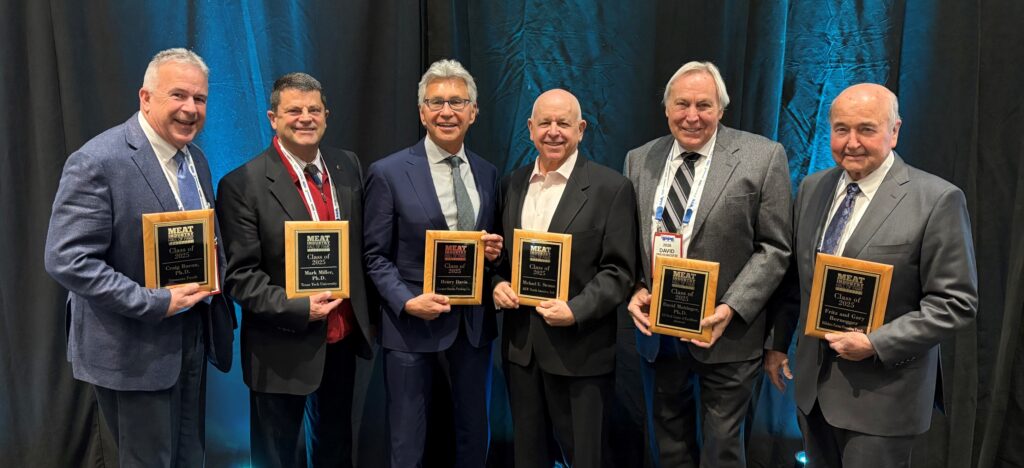
Food science alumnus (’87, ’90) earns Meat Industry Hall of Fame honors after decades of industry leadership
In recognition of his more than 35 years as an industry leader, food science alumnus Craig Bacon (MS ’87, PhD ‘90) was recently inducted into the Meat Industry Hall of Fame. In the words of the selection committee: “Honored with the American Meat Science Association Achievement Award, the Signal Service Award, and multiple FFA distinctions, Bacon’s career demonstrates a commitment to people, excellence, and industry progress.”
Bacon worked at Tyson Foods for 27 years, the last 15 as head of Research and Development, before moving to Simmons Foods in 2017, where he oversaw all technical services. In early 2026, he retired from his position at Simmons and was named head of the Department of Food Science at the University of Arkansas.
A lifelong learner and teacher, Bacon returned to campus in February 2026 to visit with students and recruit potential interns. We sat down with him to learn more about his story.
Your career path hasn’t exactly been a straight line. How did you end up at the Herbert College of Agriculture for graduate school?
I grew up in southwest Missouri on a dairy farm and came up through FFA and showed Hereford cattle. I went to the University of Missouri as an agricultural education major, mostly because I wanted to be on the livestock judging team. Jerry Lipsey, our livestock coach, wanted us to get experience judging meat so we’d be better able to evaluate live animals. I really had no idea what meat judging was, but I ended up doing well.
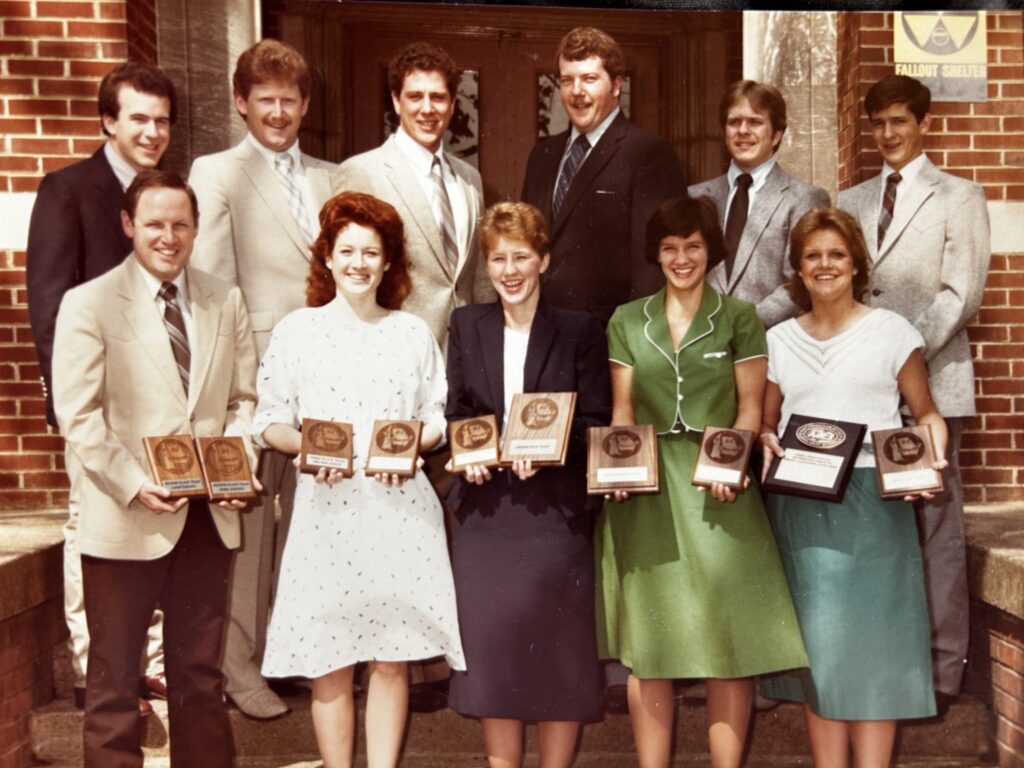
When I graduated, I planned to go to the University of Nebraska and coach the meat judging team with Dr. Dwight Loveday, but when he accepted a position at the University of Tennessee, he asked me to follow him. Within a month, my wife Debbie and I changed plans and moved to Knoxville.
I didn’t know what I was going to do when I arrived. I thought I was going to go to the university to teach, but as I tell kids all the time, your career is not a straight line. There’s always a new turn.
When you arrived at UT, you stepped into a relatively small food science program, but a number of those people, including you, became leaders in the food industry.
When you have a really successful program in a specific area, you see the influence it can have not only on the state of Tennessee but on an entire industry. I was here from ’84 to ‘90. I think there were twelve graduate students who had a meat focus, and it was a strong group of folks.
Bill Barron (MS ’88) and I headed to Wisconsin to work at Oscar Mayer, where he spent his career. Robert Pace (BS ’84, MS ’86) has been really successful in the meat industry. Keith Moore (BS ’82, MS ’85) was in that period and went on to be a leader in the packaged meat category for Cryovac. Dr. Jim Riemann, who served on the committees for both of my degrees, was president of Certified Angus Beef for a number of years and led R&D at Cargill Meat Solutions in Wichita. Jim was a 2019 Hall of Fame inductee.
When I was acknowledged by the Meat Industry Hall of Fame, I started counting all the professors who were a part of my journey. I don’t want to leave anyone out because all of them influenced me and allowed me to build that base knowledge and experience. I certainly had that here, a really strong department that fully prepared me.
Any other prized memories from your time in Knoxville?
Graduate school was more than just classes. Debbie and I got out a lot. We touched livestock events from one end of the state to the other, from West Tennessee to East Tennessee. We interacted with a lot of livestock producers. We interacted with 4-H and FFA kids through both livestock and meats.
Debbie did Extension work in Campbell County while we were here, so we lived in Campbell County, and I drove in every day to graduate school. If you want to get a taste of the state, get involved in county and Extension work. Debbie and I still hear from some of those kids; some in Campbell County had never been to Knoxville, let alone Nashville. Some of those kids are now doing things they would have never imagined.
How did you transition from being a food scientist to becoming a successful executive? Those two roles don’t necessarily require the same skill set.
As you go through a career, at some point you hit a management decision tree. Up until that point, it’s always about what you do, and that shifts suddenly to how you lead. The folks who do really well in that transition have always been good leaders; they just hadn’t yet been given the title. You have to be a good listener. I work on this all the time. It’s no longer about what you’re doing; it’s how you’re helping. It’s being a buffer sometimes to things that are going on that aren’t going to help anyone be more productive. It’s also setting a really clear direction, moving big groups towards strategic goals.
In the last two jobs I’ve led a couple hundred professionals and scientists. Some scientists need to remain scientists. They don’t want to lead people. And I think it’s important that you give them an opportunity to continue to grow, not to force them into management. Because the people under them won’t flourish, they won’t get good direction, and they’ll hate coming to work every day.
Any advice for “moving big groups toward strategic goals”?
When you take on new leadership responsibilities, one of the most important things is helping set the strategic direction and mission. And when you can do that as a group, everybody’s fingerprints are on it.
Just as important as getting buy-in from the team is putting key performance indicators (KPIs) around it, so that you actually know you’re making steps towards whatever that goal is. If we do a strategic planning process, but don’t establish any kind of measurements against it and put it in a file drawer, then it really wasn’t very important. But if you put it in place and then put in annual goals and KPIs against it, you’ll see that you make tremendous progress towards whatever that goal is.
I know you’ve been meeting with students during your visit. How do you evaluate the talent and potential of a young professional?
I often say that my number one job is talent. Most people would say, well, it’s got to be the technical aspect, the food safety, the new products. But at the end of the day, it’s having folks underneath my responsibility who are the best talent. You’re only as good as whatever that talent pool looks like.
The head of HR at Tyson Foods years ago would talk to the Emerging Leader program, a select group of 30 individuals who were the up-and-comers, and he would always tell them that in his 30-year career, he had never let anybody go because of their technical ability. It’s always people skills. I think that’s the one thing we can still work on more in higher education: getting students prepared with soft skills, people skills, communication skills. Ultimately, how you get along with others is going to determine how well you do, more so than your degree or how smart you are.
What should I know about the meat industry that isn’t common knowledge?
The meat industry is even broader than you probably think. Simmons is a pet food manufacturer and a poultry company that you’ve never heard of, right? This is what I usually ask students: What’s your favorite chicken sandwich? Most say Chick-fil-A. Simmons has twice been named Supplier of the Year to Chick-fil-A. You’ve been eating our chicken and just didn’t know it. If you go through a late-night drive-thru, where would you get chicken? Most say Taco Bell. The cantina chicken was one of our innovations.
The fun stuff is all the new products. The more challenging side is that I’ve got to do all that and make sure I don’t hurt someone. How do I make sure these food products are made in such a way that they’re always safe and nutritious and meet all their needs?
Simmons is an important manufacturer of pet food. Do the same safety and nutritional guidelines apply there as well?
When you buy wet pet food in a can, a cup, or as parts, that is Simmons. It just doesn’t have our name on it. What we feed our pets is becoming a really big deal. Pets eat what we call a static diet. You probably feed your pet the same thing for every meal. That means it’s got to be perfect. It’s not like what humans do. This morning I had a breakfast burrito, but last night I had a steak. Nutritionally, I can blend it all together, and it probably works out okay. For pets, it has to be perfect.
Pet food is really fun but challenging for our group because we have to think about the 42 nutrients that must be in every serving. We’ve got to maintain food safety. What are the risks that might be associated with making that food? And as much as we’d never want to hurt a person, amplify that even more for how much a pet parent worries about harming their pet.
Speaking of product innovations, I have to ask about the chicken wing story.
It’s true. I was present when Domino’s and Pizza Hut came in and said they’d like to cook some wings in their pizza ovens. Prior to that, you just got pizza at a pizza place. What a difference a few years makes! Traditionally, chicken wings were converted into pet food because no one wanted them. This thing became popular to the point that — I forget the exact number — the wings from the Super Bowl could be lined up across the country 23 or 24 different times.
It’s a great example of how, when you’re involved in food, you can influence the way people eat. Wings season used to just be through the Super Bowl. It’s now through March Madness. From the beginning of football season until the end of March Madness, we can’t get enough wings. We have to start making them as soon as March Madness is over and build up supply in order to have them in the fall.
In hindsight, it’s amazing how the educational opportunities that meat judging presented at Missouri and Tennessee led to this. But this is the role of a land-grant university: give someone the opportunity to get an education and experience, build on that, and one day they might get put into the Hall of Fame.